10 Top AI Skills Every Professional Needs to Learn
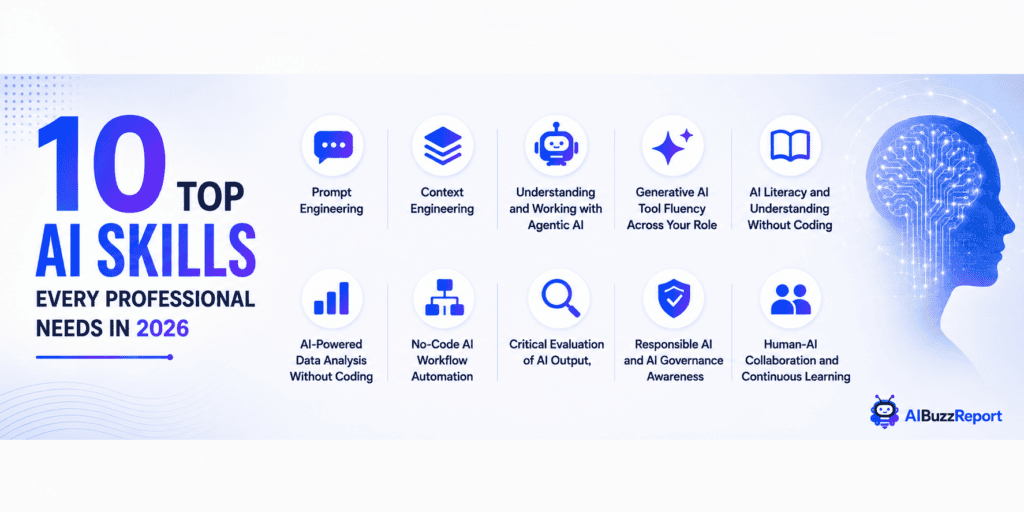
Your colleagues are finishing in half the time, job postings list tools you have never heard of, and the question you keep pushing aside is finally worth asking: am I falling behind? The AI skills professionals need in 2026 are no longer a tech-team advantage. They are the new baseline for every role, and the gap between those who have them and those who do not is widening fast. In this guide, you will learn:
- The 10 most in-demand AI skills for non-technical professionals in 2026
- Which top AI skills to prioritise based on your role and experience level
- How long each skill takes to learn and what it pays in India
- The generative AI skills your employer is already looking for
- The skills you can safely skip (no one tells you this)
Explore more career resources in our AI careers and skills hub.
Table of Contents
- Why Every Professional Needs AI Skills Right Now
- Skill 1: Prompt Engineering for Real Work Tasks
- Skill 2: Context Engineering, the Next Level After Prompting
- Skill 3: Understanding and Working with Agentic AI
- Skill 4: Generative AI Tool Fluency Across Your Role
- Skill 5: AI Literacy and Understanding Without Coding
- Skill 6: AI-Powered Data Analysis Without Coding
- Skill 7: No-Code AI Workflow Automation
- Skill 8: Critical Evaluation of AI Output
- Skill 9: Responsible AI and AI Governance Awareness
- Skill 10: Human-AI Collaboration and Continuous Learning
- AI Skills and Salary: What the Numbers Look Like in India
- Full Comparison: All 10 AI Skills at a Glance
- AI Skills You Can Safely Skip in 2026 (Unless You Are in a Technical Role)
- Your 30-Day AI Upskilling Roadmap
- The Skills That Will Define Careers in 2026
- Tools We Actually Use to Build These Top AI Skills
- Frequently Asked Questions
Why Every Professional Needs AI Skills Right Now
Most professionals still assume artificial intelligence skills are only for engineers or data scientists. That assumption is becoming expensive very fast.
According to PwC’s 2025 Global AI Jobs Barometer, industries making the greatest use of AI have achieved nearly 4x higher productivity growth. And AI-exposed roles are seeing skills change 66% faster than in non-AI roles. Employers are not just hiring AI specialists anymore. They expect every knowledge worker to work alongside generative AI tools confidently and critically.
What happens when you lag behind on AI skills?
You spend hours on tasks that AI finishes in minutes. You get bypassed for promotions when peers demonstrate AI-powered output. And over time, roles that show no AI fluency quietly disappear from job descriptions altogether.
The good news is that most of these skills are learnable in weeks, not years. You do not need a computer science degree or a coding background. And building them now is the single most direct way to future-proof your career in a future of work that is shifting faster than any previous technological transition.
Here is that clarity, broken down skill by skill.
Now that you understand what is at stake, let us go through each skill, starting with the one that delivers the fastest return for non-technical professionals.
Skill 1: Prompt Engineering for Real Work Tasks
Prompt engineering is the practice of writing clear, structured instructions that get the best output from large language models (LLMs) like ChatGPT, Claude, or Gemini. It is the single highest-leverage AI skill for any professional in 2026, and the fastest to learn.
You do not need to understand how LLMs work internally. You need to understand how to direct them effectively. A vague prompt gives you a generic answer. A structured prompt gives you a first draft, a strategy, or an analysis you can actually use.
Professionals who master prompt engineering report saving 2–3 hours per day on writing, research, and summarisation tasks.
What does strong prompting actually look like?
Strong prompting means giving the AI a role, context, a specific format, and clear constraints. For example: “You are a senior HR manager. Write a 200-word rejection email that is warm but firm. Avoid corporate jargon.”
How to learn prompt engineering without a technical background
- Start with LearnPrompting.org (free, beginner-friendly, no coding required)
- Practice daily on ChatGPT or Claude using real tasks from your job
- Study prompt libraries on PromptHero and FlowGPT
- Test the same prompt across different tools to compare outputs
Time to working proficiency: 1–2 weeks of daily practice
Difficulty: Low. No technical background required.
India salary impact: 15–25% productivity premium recognised in performance reviews
Skill 2: Context Engineering, the Next Level After Prompting
Most AI guides stop at prompt engineering. But in 2026, context engineering is what separates advanced AI users from casual users. Context engineering means structuring the full information environment you feed to an AI system, including prior instructions, constraints, memory, and role framing, so it performs reliably across complex, multi-step tasks.
Computerworld described it as “prompt engineering on steroids.” IIT Madras now runs an advanced programme in “Applied AI and ML with Context Engineering,” and enterprise teams at Infosys and Wipro have started including it in AI job requirements across India.
Think of prompting as asking a smart question. Context engineering is building the room that question happens in.
Where context engineering applies at work
- Building AI assistants that stay on-brand across all your content and communications
- Creating repeatable research workflows that maintain consistency over time
- Managing multi-step AI tasks without losing coherence (directly feeds into Skill 3)
Time to working proficiency: 3–4 weeks
Difficulty: Medium. Builds directly on prompt engineering.
Skill 3: Understanding and Working with Agentic AI
Agentic AI is the breakout skill of 2026, and it is missing from almost every career guide published this year. Agentic AI systems do not just answer questions. They plan, take actions, use tools, and complete multi-step workflows with minimal human input. Think of them as AI that operates more like a capable junior colleague than a search engine.
Tools like Zapier Agents, Relevance AI, and Claude’s tool-use capabilities are already used by lean teams in Indian startups to handle operations that previously required two or three full-time hires.
According to Gartner’s 2025 Hype Cycle, agentic AI is the top enterprise AI investment priority for 2026 and professionals who understand how to direct these systems will be disproportionately valuable in operations, product, and strategy roles.
What you need to know about agentic AI as a non-technical professional
- How AI agents plan and break complex goals into smaller tasks
- When to use an agent vs. a standard AI prompt
- How to set guardrails so agents stay within defined boundaries
- Which agentic platforms are built for non-technical users (Zapier Agents, Make.com, Relevance AI)
Time to working proficiency: 4–6 weeks
Difficulty: Medium-High
Skill 4: Generative AI Tool Fluency Across Your Role
Generative AI refers to AI systems that create new content including text, images, code, data summaries, and presentations, from a simple instruction. In 2026, generative AI tools are embedded into platforms that professionals use every day: Microsoft 365, Google Workspace, Salesforce, Notion, and Canva.
AI tool fluency means knowing which generative AI tool fits which task, how to feed it the right inputs, and how to quality-check its outputs. It is not about knowing every tool. It is about building the habit of reaching for AI first and knowing when not to.
According to McKinsey’s 2024 State of AI report, 75% of knowledge workers already use generative AI tools in some form, often without formal company deployment.
Generative AI tools by professional function
| Function | Best Generative AI Tools | What They Replace |
|---|---|---|
| Marketing & Content | Jasper AI, Copy.ai, Canva AI | First draft creation, design briefs |
| HR & Recruitment | ChatGPT, Grammarly AI | Job descriptions, offer letters, FAQs |
| Finance & Operations | Microsoft Copilot, Notion AI | Report summaries, meeting notes |
| Sales | HubSpot AI, Instantly.ai | Cold email sequences, follow-ups |
| Customer Support | Intercom AI, Freshdesk AI | Ticket responses, knowledge bases |
Time to working proficiency: 1–2 weeks per tool
Difficulty: Low
Skill 5: AI Literacy and Understanding Without Coding
AI literacy means knowing what AI can and cannot do, without writing a single line of code. It covers how large language models learn from data, why they hallucinate (produce false information confidently), and how to evaluate AI output before acting on it.
This skill matters because AI-literate professionals make better decisions at every stage of work. They know when to trust the output, when to verify it against a primary source, and when to skip AI entirely. According to McKinsey, organisations with high AI literacy across all functions see 30% faster AI adoption ROI.
Why AI literacy is not just for tech teams
A finance professional with AI literacy catches a hallucinated number before it enters a report. A recruiter understands why an AI screening tool may carry demographic bias. A marketing manager knows when AI-generated copy needs a legal review before publishing.
These are daily workplace situations in 2026, not hypothetical ones.
Best free resources to build AI literacy in India
- Google AI Essentials on Coursera (free audit, globally recognised certificate)
- Elements of AI by the University of Helsinki (free, 6 hours)
- Microsoft AI Skills Initiative (free, certificate included)
- upGrad AI Fundamentals (India-focused, available in Hindi and English)
Time to working proficiency: 1–2 weeks
Difficulty: Low
India salary impact: Non-technical professionals who develop AI literacy can achieve salary increases of 30–40% within 12–18 months, according to industry benchmarks.
Skill 6: AI-Powered Data Analysis Without Coding
You do not need to be a data analyst to work with data in 2026. Generative AI tools now let any professional ask questions in plain language and receive charts, summaries, and business insights in seconds.
Microsoft Copilot in Excel, ChatGPT’s Advanced Data Analysis, and Polymer allow you to upload a spreadsheet and ask: “What drove the spike in returns last quarter?” or “Which customer segment has the lowest 90-day retention?”
PwC’s AI Jobs Barometer found that AI-exposed roles are growing at nearly 4x the rate of non-exposed roles and data analysis is one of the highest-impact AI use cases for non-technical professionals.
Pros and cons of AI data tools for non-technical professionals
Pros:
- No coding or SQL required for standard business analysis
- Cuts analysis time from hours to under 30 minutes in most cases
- Produces shareable, boardroom-ready charts and summaries
- Accessible to HR, finance, marketing, and operations professionals equally
Cons:
- AI misreads ambiguous or poorly structured data without careful framing
- Sensitive company data creates a privacy and compliance risk in cloud tools
- Outputs must always be verified by someone with domain expertise before presenting
- Quality of insight depends entirely on the quality of the underlying data
Time to working proficiency: 2–3 weeks Difficulty: Low-Medium
[IMAGE: AI data analysis tools professionals 2026 Microsoft Copilot Excel India]
Skill 7: No-Code AI Workflow Automation
Workflow automation is no longer the exclusive domain of IT departments. No-code AI platforms like Zapier, Make.com, and n8n let any professional connect apps, trigger actions, and build AI-powered processes without writing a single line of code.
Professionals who automate even 20% of their repetitive work save an average of 6 hours per week, according to Zapier’s 2024 State of Business Automation report. Across Bangalore, Hyderabad, and Mumbai, startups are actively hiring professionals who can build these workflows independently, without relying on a developer.
What you can automate right now without any coding
- Lead capture from web forms to CRM, automatically
- AI-generated summaries of emails, Slack messages, and meeting recordings
- Weekly reports auto-generated from multiple data sources
- Content scheduling across social channels based on a content calendar
Time to working proficiency: 2–3 weeks Difficulty: Low-Medium India salary impact: ₹2–4L salary uplift reported in operations and product roles with demonstrated automation skills.
Skill 8: Critical Evaluation of AI Output
AI output evaluation is the skill of reviewing, verifying, and improving what a generative AI tool produces. This is what separates professionals who use AI well from those who quietly create liability for their organisation.
Generative AI hallucinates. It fabricates facts, misattributes quotes, and occasionally generates content that is legally or factually problematic. A 2024 Stanford study found that AI tools produced factually incorrect information in 23% of complex professional queries, even when responding confidently.
A five-step framework for evaluating AI output
- Cross-check all factual claims against the original primary source
- Verify every numeric data point against the report or dataset it came from
- Run AI-written content through plagiarism detection before publishing externally
- Apply your own domain expertise to judge whether the output actually fits the context
- Edit for tone, voice, accuracy, and legal compliance before sharing or submitting
Domain expertise is the multiplier here. Professionals who combine AI skills with deep domain knowledge in finance, law, healthcare, or marketing are consistently the highest earners in AI-augmented roles, according to PwC’s 2025 research.
Time to working proficiency: Ongoing. Sharpens with every AI interaction. Difficulty: Medium
Skill 9: Responsible AI and AI Governance Awareness
Understanding how to use AI responsibly is no longer optional, especially in regulated industries. India’s Digital Personal Data Protection (DPDP) Act and emerging global AI governance frameworks mean that professionals in finance, healthcare, legal, and HR must understand data privacy, algorithmic bias, and transparency obligations.
According to Gartner, 60% of enterprises will require responsible AI training for all staff by 2026. This is not a compliance checkbox. It is a leadership signal and it is increasingly showing up on ATS filters for senior roles in large organisations.
What responsible AI use looks like in practice
- Knowing which company data can and cannot be fed into third-party AI tools
- Flagging AI output that may carry demographic or historical bias before it influences decisions
- Documenting when and how AI was used in client deliverables and internal reports
- Communicating AI limitations clearly to non-technical stakeholders
How to add AI governance to your resume
- Complete IBM AI Ethics Fundamentals on Coursera (free audit)
- Reference the NITI Aayog Responsible AI Principles in your professional context
- Join your organisation’s AI Governance Council if one exists, or propose starting one
Time to working proficiency: 2–3 weeks (conceptual); ongoing (applied practice)
Difficulty: Low-Medium
Skill 10: Human-AI Collaboration and Continuous Learning
The final skill is the reframe that makes all others compound over time. Human-AI collaboration is not about using AI more. It is about knowing exactly where human judgment, creativity, and domain knowledge add the most value that AI cannot replicate.
MIT Sloan researchers note that 2026 marks the shift from AI experimentation to “finding viable solutions that create real value at scale.” The professionals who succeed are those who know when to lead with AI and when to lead with themselves.
LinkedIn Learning’s 2025 Workplace Report found that professionals who invest 1 hour per week in AI upskilling are 57% more likely to be promoted within 2 years.
Your personal AI continuous learning system
- Subscribe to 2–3 AI newsletters (The Rundown AI, TLDR AI, Ben’s Bites)
- Block 30 minutes every week to test one new generative AI tool on a real task
- Keep an “AI wins log” and track every task where AI measurably saved you time or improved your output
- Share what works with your team to build collective AI fluency
- Review your full AI tool stack every quarter and cut anything that is not delivering value
Time to set up: 1 day Difficulty: Low
[IMAGE: Human-AI collaboration continuous learning professionals India 2026]
AI Skills and Salary: What the Numbers Look Like in India
A key reason to build these skills is financial. Here is what the data shows for Indian professionals in 2026.
| AI Skill Area | Relevant Roles | Avg Salary Range (LPA) | AI Premium vs Non-AI Role |
|---|---|---|---|
| Prompt + Context Engineering | Content, Marketing, Operations | ₹8–18 LPA | +20–35% |
| Agentic AI Workflow Management | Ops, Product, Consulting | ₹12–28 LPA | +30–45% |
| Generative AI Tool Fluency | Marketing, HR, Sales | ₹7–16 LPA | +15–25% |
| AI-Powered Data Analysis | Finance, Analytics, Strategy | ₹12–30 LPA | +25–40% |
| No-Code Automation | Operations, Project Mgmt | ₹8–20 LPA | +20–30% |
| Responsible AI / Governance | Compliance, HR, Legal | ₹14–32 LPA | +25–35% |
Full Comparison: All 10 AI Skills at a Glance
| Skill | Difficulty | Time to Proficiency | India Demand | Resume Value |
|---|---|---|---|---|
| Prompt Engineering | Low | 1–2 weeks | ⭐⭐⭐⭐⭐ | High. Appears in most job postings |
| Context Engineering | Medium | 3–4 weeks | ⭐⭐⭐⭐ | Emerging. Strong differentiator |
| Agentic AI | Medium-High | 4–6 weeks | ⭐⭐⭐⭐⭐ | Very High. Rare, high demand |
| Generative AI Fluency | Low | 1–2 weeks | ⭐⭐⭐⭐⭐ | High. Baseline expectation |
| AI Literacy | Low | 1–2 weeks | ⭐⭐⭐⭐⭐ | High. ATS-friendly keyword |
| AI Data Analysis | Low-Medium | 2–3 weeks | ⭐⭐⭐⭐⭐ | Very High. Finance, ops, analytics |
| No-Code Automation | Low-Medium | 2–3 weeks | ⭐⭐⭐⭐⭐ | High. Startup demand is strong |
| Output Evaluation | Medium | Ongoing | ⭐⭐⭐⭐⭐ | Medium. Shown through portfolio |
| Responsible AI | Low-Medium | 2–3 weeks | ⭐⭐⭐⭐ | High. Regulated industries |
| Human-AI Collaboration | Low | 1 day setup | ⭐⭐⭐⭐⭐ | High. Compounds everything else |
AI Skills You Can Safely Skip in 2026 (Unless You Are in a Technical Role)
Most career guides will not tell you this. Not every AI skill belongs on your list if you are a non-technical professional.
Skip these unless your role involves building AI systems:
- Python and deep learning: Relevant for AI engineers. Not required for AI users
- Machine learning mathematics: Linear algebra and calculus are for model builders, not model users
- Fine-tuning large language models: A specialist engineering task, not a workplace skill
- Reinforcement learning and computer vision: Advanced research areas, not business-professional skills
- MLOps and model deployment: Relevant for ML engineers. Not for operations, marketing, or HR
Focus your time on the 10 skills in this guide. These are the ones that appear in actual job postings, get picked up by ATS systems, and translate directly into performance outcomes, regardless of your industry.
Your 30-Day AI Upskilling Roadmap
You do not need to learn all 10 skills at once. Here is a structured framework for working professionals who have limited time.
Week 1: AI Literacy Foundation
- Complete Google AI Essentials on Coursera (free, which builds your AI literacy baseline)
- Spend 30 minutes daily prompting ChatGPT or Claude with real tasks from your current role
- List 3 repetitive tasks in your job that a generative AI tool could handle or speed up
Week 2: Generative AI Tools in Practice 4. Sign up for free trials of 2 AI tools relevant to your function (see the table in Skill 4) 5. Build one real deliverable such as a report, email sequence, or data summary using AI 6. Share the output with a colleague and note where human judgment improved it
Week 3: Automation and Workflow 7. Create one no-code automation in Zapier or Make.com linking two apps you use daily 8. Document the exact time saved in the first week of running it 9. Identify one additional process in your team that could be partially automated
Week 4: Evaluate, Governance, and Plan 10. Audit all AI-generated work from the month for accuracy, bias, and compliance risks 11. Add your AI skills to your LinkedIn profile and CV using the language from this guide 12. Set up your continuous learning system , including newsletter subscription plus weekly test slot
The Skills That Will Define Careers in 2026
Picture this: twelve months from now, you are the person on your team who ships reports in half the time, spots errors in AI-generated data before they reach the boardroom, and quietly automates the processes everyone else still does by hand. You did not get a new degree. You did not switch careers. You just built the right ten skills, one at a time, starting with thirty minutes a day.
That is not a fantasy. It is the reality for Indian professionals who invested in AI skills early, and the window to do it before these skills become table stakes is closing faster than most people realise. The good news is that you have everything you need in this guide to start today.
Here are your key takeaways:
- Prompt engineering delivers the fastest return and requires zero technical background
- Generative AI tool fluency is already a baseline expectation in most job descriptions
- Context engineering and agentic AI are the emerging skills that set you apart in 2026
- Domain expertise multiplies every AI skill you build. It is your unfair advantage
- Responsible AI and governance are showing up in ATS filters for senior roles across India
- A consistent weekly learning habit compounds your advantage long after others stop
Start with one skill. Pick the one from the comparison table that fits your current role. Give it thirty minutes a day for two weeks and measure the impact on your output.
Ready to go deeper? Browse our full AI skills roadmap for professionals or explore the best generative AI tools to start learning with today.
Tools We Actually Use to Build These Top AI Skills
| Tool | Skill Area | Monthly Price | India Price (approx.) | Try It |
|---|---|---|---|---|
| ChatGPT Plus | Prompting, data analysis, research | $20/month | ~₹1,670 | Start free trial rel=”nofollow” |
| Quillbot | AI writing and paraphrasing | $9.95/month | ~₹830 | Try free plan rel=”nofollow” |
| Zapier | No-code workflow automation | Free–$19.99/month | Free plan available | Start free rel=”nofollow” |
| Coursera | AI literacy certifications | Free audit | Free audit available | Browse AI coursesrel=”nofollow” |
| Perplexity AI | AI research and output verification | Free plan | Free plan available | Try free rel=”nofollow” |
| Make.com | No-code automation | Free–$9/month | Free plan available | Start free rel=”nofollow” |
| Microsoft Copilot | Data analysis, Office AI | Included in M365 | ₹660–₹1,320/month | Try Copilot rel=”nofollow” |
Frequently Asked Questions
What AI skills are employers looking for in 2026?
Employers in 2026 prioritise prompt engineering, generative AI tool fluency, workflow automation, AI-powered data analysis, agentic AI awareness, and the ability to evaluate and govern AI output. These skills appear across job postings in marketing, HR, finance, operations, and product roles, not just technical teams. Adding these terms to your CV also improves ATS visibility.
Which AI skill should I learn first as a non-technical professional?
Start with AI literacy and prompt engineering in parallel. Complete Google’s AI Essentials course (6 hours, free to audit) and practice prompting daily using real tasks from your role. These two skills reinforce each other and produce visible results within two weeks.
What is the difference between AI literacy and AI skills?
AI literacy is the foundational understanding of how AI works, where it fails, and how to evaluate its output critically. AI skills are the practical applications: prompting, automation, data analysis, and tool use. You need both. Literacy prevents costly errors and applied skills deliver the productivity gains.
Are AI skills enough without domain expertise?
No, and this is one of the most overlooked points in AI career advice. According to PwC’s 2025 research, professionals who combine AI skills with deep domain expertise (finance, law, healthcare, marketing) consistently outperform those with AI skills alone. AI augments your domain knowledge. It does not replace it.
How do I add AI skills to my resume and get noticed by ATS systems?
Use specific, keyword-rich language: “prompt engineering,” “generative AI,” “no-code workflow automation,” “AI tool fluency,” “responsible AI,” “Microsoft Copilot,” and the names of specific tools you have used. Back each claim with a result: “Reduced report preparation time by 60% using AI-powered data analysis.” ATS systems scan for both the skill name and the outcome.
How relevant are AI skills for Indian professionals specifically?
Extremely relevant. NASSCOM projects India will need over 1 million AI-skilled professionals by 2027. ServiceNow’s 2024 AI Skills report predicts 2.73 million new tech jobs in India by 2028. Salary premiums for AI-skilled professionals across Bangalore, Hyderabad, Mumbai, and Delhi NCR are already 15–45% above equivalent non-AI roles.

Stay Ahead of the AI Curve
Get the latest AI trends, SaaS insights, and tech news delivered to your inbox every week.
- Daily AI & SaaS news digest
- Exclusive founder insights
- Unsubscribe anytime
Tech Insights Daily
Free forever. No spam. Unsubscribe anytime.