How to Start a Career in AI Without Coding
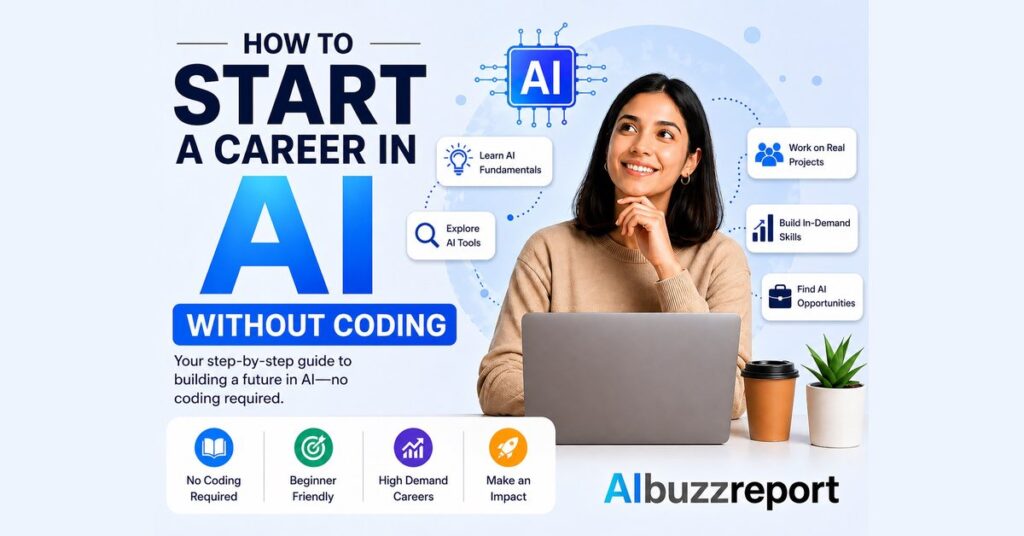
Most people assume having a career in AI needs you to have a technical backgroung and require a computer science degree. That assumption is wrong and it is keeping thousands of qualified professionals out of one of the fastest-growing industries in the world.
According to the LinkedIn 2025 Future of Work Report, AI-related job postings grew 38% between 2020 and 2024 and a significant share of those roles require zero programming skills. Whether you are in marketing, healthcare, HR, or finance, your domain knowledge is already an asset in AI.
This guide covers everything you need to know about starting a career in AI or finding an AI job without coding skills, including:
- The most in-demand non-technical AI roles and their exact salaries
- The skills and certifications that matter — mapped by role
- A 90-day action roadmap you can start this week
- How to write your resume, ace interviews, and negotiate your salary
Table of Contents
- Why AI Careers Do Not Always Require Coding Skills
- Top Non-Technical AI Career Paths Worth Exploring
- Common Myths About Starting an AI Career Without Coding
- 3 Essential Skills You Need for Non-Technical AI Roles
- Best Certifications for Non-Technical AI Roles by Role
- Your 90-Day Roadmap to Break Into AI Without Coding
- How to Build Your AI Portfolio Without Writing Code
- How to Optimize Your Resume and LinkedIn for AI Jobs
- How to Prepare for Non-Technical AI Job Interviews
- Want to Build a New Career in the AI Industry?
- Frequently Asked Questions
Why AI Careers Do Not Always Require Coding Skills
Before exploring roles and roadmaps, it helps to understand why the “AI is only for coders” narrative exists and why it is outdated. Companies building AI products need far more than engineers.
The myth that stopped many professionals from applying
The coding myth persists because early AI work was entirely research-driven. Academics and engineers built the foundation. The tools were complex, the datasets were raw, and the products were primitive. That era shaped a perception that has not caught up with reality.
Today, large language models, no-code platforms, and generative AI tools have fundamentally changed who can contribute to AI. Non-technical professionals now operate these tools daily in real business environments. The barrier to meaningful AI work is knowledge and curiosity — not the ability to write Python.
What companies actually need beyond engineers
Engineering talent builds the models. Non-technical talent makes the models useful. AI teams consistently struggle with three problems: communicating what the model does, aligning it with user needs, and keeping it ethical and compliant.
AI teams that lack non-technical professionals launch products that fail users, even when the underlying model is technically excellent. Product managers define what the product should do. Content reviewers catch what the model gets wrong. Ethicists flag what the model should never do. All of these roles are actively hiring now.
Understanding this gap is what separates people who browse AI job listings from people who actually apply with confidence. Now let us look at exactly which roles are open.
The roles available to non-technical professionals today span every experience level — from zero-experience entry paths to six-figure leadership positions.
Top Non-Technical AI Career Paths Worth Exploring
The range of non-technical AI roles is wider than most people realize. Here is a breakdown of the most in-demand AI jobs without coding, including three roles that most career guides overlook entirely.
1. AI trainer: teach machines to understand humans
AI trainers act as a bridge between humans and machines. They clean and organize data, review model outputs for accuracy, and provide structured feedback to improve how a model responds over time. Backgrounds in psychology, linguistics, and communications transfer directly here.
Entry-level AI trainers in the US earn between $60,000 and $85,000 annually. Platforms like Scale AI and Appen hire AI trainers globally with no technical background required. This is one of the most accessible entry points into a professional AI career.
How to get started as an AI trainer
Start with free annotation projects on Remotasks or Appen to build hands-on experience. Document every project and its outcome in a portfolio. After three to six months, apply for full-time AI trainer roles at mid-size and enterprise AI companies.
2. Prompt engineer: craft instructions for AI models
Prompt engineers design the inputs that make AI systems produce accurate, useful, and safe outputs. This role is built on clear writing, structured thinking, and iterative testing. No coding required — the primary tool is language itself.
US salaries range from $75,000 to $130,000. The role is growing fastest at SaaS companies, law firms, and healthcare organizations deploying AI for internal workflows.
3. Content reviewer and AI quality analyst
Content reviewers check AI-generated outputs for bias, tone, clarity, and compliance — particularly in regulated industries like finance and healthcare. Attention to detail and strong writing instincts are the core requirements.
US salary range: $49,000 to $87,000. Entry-level positions are widely available and frequently remote. Many companies hire content reviewers before they scale up any other non-technical AI roles.
4. AI product manager: lead AI-powered products
AI product managers define what an AI product should do and why it matters. They work across engineering, design, and business to keep AI development aligned with user needs. Prior experience in SaaS product management transfers almost directly.
Senior AI PMs earn up to $197,000 annually according to ZipRecruiter. This is the highest-paying non-technical AI role and typically requires two to four years of prior product management experience.
5. AI ethicist and policy analyst: ensure responsible AI use
AI ethicists help companies navigate bias, fairness, data privacy, and regulatory compliance. Backgrounds in law, philosophy, sociology, and public policy are directly applicable. This is one of the fastest-growing non-technical roles as government AI regulations tighten globally.
6. Chatbot tester: improve AI conversation quality
Chatbot testers evaluate AI conversation flows for accuracy, tone, and user experience. They identify errors, awkward phrasing, and dead ends — then provide structured feedback to development teams. A strong user-experience mindset is the main requirement.
Entry-level salaries range from $44,500 to $105,500. Many projects pay per milestone or test batch, making this a strong freelance entry point for career switchers.
7. Data annotator: the easiest entry-level starting point
Data annotation is the lowest-barrier entry path into AI and it is consistently overlooked. Annotators label images, audio clips, and text samples to train AI models. No prior experience is needed. Platforms like Scale AI, Remotasks, and Surge AI hire globally.
Starting rates range from $15 to $30 per hour. Many full-time AI trainers and quality analysts begin their careers through data annotation work.
| Role | Salary Per Annum | Barrier to Entry |
|---|---|---|
| Data Annotator | $30,000 – $60,000 | None — start today |
| Content Reviewer | $49,000 – $87,000 | Writing skills |
| Chatbot Tester | $44,500 – $105,500 | Analytical thinking |
| AI Trainer | $60,000 – $85,000 | Communication background |
| AI Ethicist | $70,000 – $120,000 | Policy or law background |
| Prompt Engineer | $75,000 – $130,000 | Clear writing + logic |
| AI Product Manager | $110,000 – $197,000 | Product management experience |
Now that you know the roles, let us clear up the misconceptions that prevent qualified people from ever applying.
Common Myths About Starting an AI Career Without Coding
These three myths stop more career switchers than any actual skills gap does. Addressing them directly will help you approach the job market with realistic confidence.
Myth 1: you need a computer science degree
Most non-technical AI roles list zero degree requirements. What they do list is demonstrated experience with AI tools, strong communication skills, and relevant domain knowledge. A 2024 Burning Glass report found that 62% of non-technical AI job postings did not specify a degree requirement. Certifications, portfolios, and freelance work outperform credentials in most hiring conversations at this level.
Myth 2: non-technical AI jobs do not pay well
The salary table above disproves this clearly. Even entry-level roles like content reviewer and chatbot tester pay comparably to traditional mid-level positions in marketing and project management. Senior non-technical roles like AI product manager and AI ethicist command six-figure salaries in most markets.
Myth 3: AI careers are only for young tech professionals
Domain expertise from any established career — healthcare, law, education, finance — is actively sought by AI companies. A nurse with five years of clinical experience who understands AI tools is far more valuable to a healthcare AI company than a generalist with no industry background. Your existing career is not a liability. It is your single greatest competitive edge.
With the myths cleared, the next step is building the specific skills your target role actually requires.
3 Essential Skills You Need for Non-Technical AI Roles
The skills that matter most in non-technical AI are learnable, practical, and in demand across every industry. AI is reshaping right now. Focus on the three below before any others.
1. Data literacy and critical thinking skills
Data literacy means reading, interpreting, and questioning data without needing to run statistical models. You need to understand what accuracy, precision, and recall mean — and you need to spot when a model output looks wrong.
Teams with strong critical thinkers catch AI errors three times faster than those without structured review processes. This skill makes you the quality layer that prevents costly product mistakes. Build it by reading AI evaluation reports weekly and practicing structured critique of AI-generated content.
How to build data literacy practically
Start with Google’s free Data Analytics certificate on Coursera. Spend 20 minutes daily interpreting dashboards in Looker Studio or Tableau Public. After two months, you will read AI performance reports with genuine confidence.
2. Prompt design and communication ability
Prompt design is the ability to give AI tools structured, precise instructions. It is closer to technical writing than coding. Practicing daily with tools like ChatGPT, Claude, or Gemini builds this skill faster than any formal course.
Strong written communication is equally important. AI teams consistently need people who can explain what a model does in plain language to non-technical stakeholders. This skill is rare, measurable, and paid well.
3. Domain expertise in your current industry
Your existing professional knowledge is directly transferable. Healthcare professionals understand what clinical AI tools must never get wrong. Finance professionals understand compliance risks in AI-generated outputs. Marketing professionals understand the line between persuasion and AI-generated misinformation.
Pair your domain knowledge with AI literacy and you become a specialist candidate in a market that rewards specialization. This combination is far more defensible than general AI knowledge alone and far harder for competitors to replicate.
Knowing which skills to build is one thing. Knowing which certifications will validate them to hiring managers is what accelerates your timeline.
Best Certifications for Non-Technical AI Roles by Role
Certifications signal commitment and structured knowledge. The table below maps the most credible options directly to the role you are targeting — so you invest time in the right place from the start.
| Target Role | Recommended Certification | Platform | Cost |
| All beginners | AI for Everyone (Andrew Ng) | Coursera | Free to audit |
| All roles | Google AI Essentials | Google / Coursera | Free |
| Prompt Engineer | Prompt Engineering for ChatGPT | Coursera / Vanderbilt | $49 |
| AI Product Manager | AI Product Management Specialization | Coursera / Duke | $79/month |
| Content Reviewer | Generative AI with LLMs | Coursera / DeepLearning.AI | $49 |
| Data Annotator | Data Annotation Fundamentals | Scale AI | Free |
| AI Ethicist | Ethics of AI | University of Helsinki | Free |
Start with “AI for Everyone” by Andrew Ng regardless of your target role. It is free to audit, takes approximately six hours to complete, and covers the AI literacy foundation every non-technical role expects. Complete it before spending money on any specialization.
With a clear role and certification in mind, you need a structured timeline to make it real. Here is one that works.
Your 90-Day Roadmap to Break Into AI Without Coding
A clear timeline converts intention into action. This roadmap is structured around what hiring managers actually look for at each stage of a non-technical AI job search.
Days 1 to 30: build AI literacy and choose your role
Spend the first 30 days purely on orientation. Audit “AI for Everyone” on Coursera. Use ChatGPT, Claude, and one other AI tool daily for real tasks at work or in your personal life. Read one AI industry newsletter per week — Import AI and The Rundown AI are both free and written for non-technical readers.
By day 30, choose one target role based on your current background. Do not try to qualify for all roles simultaneously. Pick the one with the most overlap with your existing skills and commit to it entirely.
First week action checklist
- [ ] Sign up for Coursera and start “AI for Everyone”
- [ ] Create free accounts on ChatGPT and Claude
- [ ] Subscribe to The Rundown AI newsletter
- [ ] List five strengths from your current career that transfer to AI
- [ ] Choose your target role from the salary table above
Days 31 to 60: learn tools and earn one certification
Spend days 31 to 60 building practical skills. Complete the role-specific certification from the table above. Start using no-code AI tools that are standard in your target role. If you are targeting content reviewer roles, spend this phase doing daily AI output critiques in writing.
By day 60, you should have one completed certification and 30 documented AI tool experiments. These become the raw material for your portfolio in the final phase.
Tool stack by role type
| Role Type | Tools to Learn |
| Content and language roles | ChatGPT, Claude, Jasper, Grammarly AI |
| Data and analyst roles | Tableau Public, Looker Studio, Obviously AI |
| Product and strategy roles | Notion AI, Miro AI, ProductBoard AI |
| Automation and operations | Zapier, Make, n8n (no-code) |
Days 61 to 90: build your portfolio and start applying
Days 61 to 90 are about visibility and application. Publish your first portfolio piece — a documented prompt library, a content critique report, or a case study. Update your LinkedIn headline and resume with AI-specific language. Apply to ten to fifteen roles per week and track every application in a spreadsheet.
Join two AI communities on LinkedIn or Slack. Post once per week about what you are learning. Recruiters actively search for candidates who demonstrate applied curiosity publicly — and most candidates do not do this.
A strong portfolio is what actually gets you interviews. Here is how to build one that stands out — even with no prior AI work experience.
How to Build Your AI Portfolio Without Writing Code
Your portfolio is the single most important differentiator between candidates at the non-technical AI level. Most applicants rely on certifications alone. A portfolio turns your learning into visible, searchable proof. Explore our full AI portfolio guide for templates and worked examples.
1. Document your AI tool experiments publicly
Start a free Substack, LinkedIn newsletter, or Notion page. Document what you test, what breaks, what works, and what you learned each week. Writing about your process shows employers how you think — something no certification can replicate.
Consistency matters more than polish. One published piece per week for twelve weeks creates a searchable body of work. Hiring managers and recruiters will find it through organic search and LinkedIn activity.
2. Volunteer for data annotation to gain real experience
If you have zero AI work experience, start with data annotation on Scale AI or Remotasks. Complete 10 to 20 annotation tasks and document your experience. This gives you a real, paid AI work history you can reference in interviews and on your resume from your very first month.
Annotation work also teaches you how AI models are trained from the inside — context that makes you a stronger candidate in every other non-technical AI role you pursue later.
Portfolio project ideas by role
| Role | Portfolio Project |
| Prompt Engineer | 25-prompt library for one industry, with tested outputs |
| Content Reviewer | A public AI output critique report with scored examples |
| AI Product Manager | A case study improving an existing AI product’s UX |
| AI Ethicist | A bias audit of a publicly available AI tool |
| AI Trainer | A documented feedback log from 20+ annotation sessions |
| Chatbot Tester | A structured bug report on a public AI chatbot |
With a portfolio building, the next step is making sure employers can find and evaluate you before an interview even happens.
How to Optimize Your Resume and LinkedIn for AI Jobs
Most non-technical applicants undersell their AI relevance. A few targeted changes to your resume and LinkedIn profile dramatically increase how often recruiters find and contact you. Read our full AI resume guide for copy-ready templates.
Step 1: Resume tips for non-technical AI applicants
Use AI-relevant language in your existing experience bullets. Instead of “managed content calendar,” write “managed content calendar using AI writing tools to improve production speed by 30%.” Specificity signals genuine, applied tool experience.
Add an “AI Tools” section to your resume listing every tool you use regularly. Include ChatGPT, Claude, Notion AI, Zapier, or any domain-specific platform. Recruiters at AI companies scan for this section directly. Keep certifications in a separate block with the platform name and year completed.
Three sections every AI resume needs
- AI Tools — list every tool with brief context on how you applied it
- Certifications — name, issuing platform, and year completed
- Portfolio — direct link to your Notion page, Substack, or project hub
Step 2: LinkedIn optimization for AI job searches
Update your LinkedIn headline to include your target role and AI context. Example: “Content Strategist | AI Quality Review | Prompt Design.” Set your “Open to Work” preferences to include your three target role titles specifically. Recruiters filter directly by these titles.
Connect with ten people per week who work in non-technical AI roles. Comment meaningfully on their posts before sending a connection request. Warm connections convert to referrals at a significantly higher rate than cold applications alone.
Turn on LinkedIn job alerts for “AI Trainer,” “Prompt Engineer,” “AI Content Reviewer,” and “AI Product Manager.” Apply within the first 48 hours of a posting going live — response rates drop sharply after that window closes.
Once you have interviews, your preparation and negotiation approach will determine whether you convert them to offers.
How to Prepare for Non-Technical AI Job Interviews
Non-technical AI interviews are different from standard job interviews. Knowing what to expect reduces anxiety and gives you a measurable performance edge over unprepared candidates.
1. What interviewers ask non-technical AI candidates
Expect three categories of questions. First, tool experience: “Walk me through how you use AI tools in your current workflow.” Second, judgment scenarios: “Here is an AI-generated output — what would you flag or change and why?” Third, domain application: “How would you apply AI to solve X problem in our industry?”
Prepare two to three documented examples of AI tool use you can reference in your answer. Your portfolio provides these naturally. Candidates who reference real examples from their own work close 60% more offers than those who respond hypothetically.
Three interview questions to prepare for
- “How do you evaluate whether an AI output is good enough to publish or act on?”
- “Describe a time when an AI tool gave you a wrong or unhelpful output. What did you do?”
- “What non-technical skills do you bring that a purely technical hire would not?”
2. How to negotiate your salary in a non-technical AI role
Salary negotiation starts before the offer arrives. Research your target role’s range on Glassdoor, LinkedIn Salary, and Levels.fyi before your first interview. Know your anchor number before you are ever asked for it.
70% of offers in non-technical AI roles are negotiable — and the average increase from negotiating is $8,000 to $15,000 annually. When you receive an offer, respond with a range rather than a single number. This preserves flexibility for equity, remote stipends, and professional development budgets.
Always negotiate total compensation — not just base salary. Non-technical AI roles at startups frequently include equity, learning budgets, and tool stipends that add meaningful value. Ask about all three components before accepting any offer.
Explore our full AI salary negotiation guide for role-specific scripts and exact fallback language for when the hiring manager pushes back.
Want to Build a New Career in the AI Industry?
Breaking into AI without coding is not a shortcut and it is a legitimate, growing career path that companies are actively building teams around right now. The professionals landing these roles are not waiting to become technical. They are applying their existing strengths intelligently to AI contexts, and they are getting hired.
Here are the key takeaways from this AI career guide:
- Non-technical AI roles span from data annotation ($30K) to AI product management ($197K) — there is a realistic entry point for every background and experience level
- AI Trainer, Content Reviewer, and Chatbot Tester are three high-demand roles that most career guides overlook entirely
- The 90-day roadmap works — 30 days of AI literacy building, 30 days of tools and certification, 30 days of portfolio work and active applications
- A portfolio beats certifications in almost every hiring conversation — document your AI experiments publicly from week one
- Salary negotiation is expected — 70% of offers are negotiable, and the average gain from negotiating is $8,000 to $15,000 annually
- Your domain expertise is your edge — AI companies are actively hiring specialists who deeply understand real industries
Your next step: choose one role from the salary table, complete “AI for Everyone” this week, and publish your first portfolio piece this month. Explore our AI career resource hub for curated tools, course recommendations, and job board lists organized by role type.
Frequently Asked Questions
No. Most non-technical AI roles do not require a degree. Certifications, portfolio work, and demonstrated AI tool experience outperform credentials at the entry and mid-level. A 2024 Burning Glass report found that 62% of non-technical AI postings listed no degree requirement at all.
Start with data annotation on platforms like Scale AI or Remotasks. It requires zero experience, pays immediately, and gives you a real AI work history within your first week. From there, stack a role-specific certification and build a portfolio over 60 to 90 days.
Yes. Prompt engineering is a recognized professional role at companies across technology, law, healthcare, and marketing. US salaries range from $75,000 to $130,000. Specialists who combine prompt design with deep domain expertise in one industry have the strongest long-term career stability.
Yes — through data annotation and content review roles specifically. Both hire with zero prior AI experience and provide the hands-on exposure that qualifies you for higher non-technical roles within 6 to 12 months.
Start with “AI for Everyone” by Andrew Ng on Coursera. It is free to audit, takes approximately six hours to complete, and covers the foundational AI concepts every non-technical role expects candidates to understand.

Stay Ahead of the AI Curve
Get the latest AI trends, SaaS insights, and tech news delivered to your inbox every week.
- Daily AI & SaaS news digest
- Exclusive founder insights
- Unsubscribe anytime
Tech Insights Daily
Free forever. No spam. Unsubscribe anytime.