Will SaaS Be Replaced by AI? A Realistic Look at the Future of Software
If you have been asking this question lately, you are not alone. SaaS founders, product leaders, and investors are all wrestling with the same concern: is AI about to make our software irrelevant?
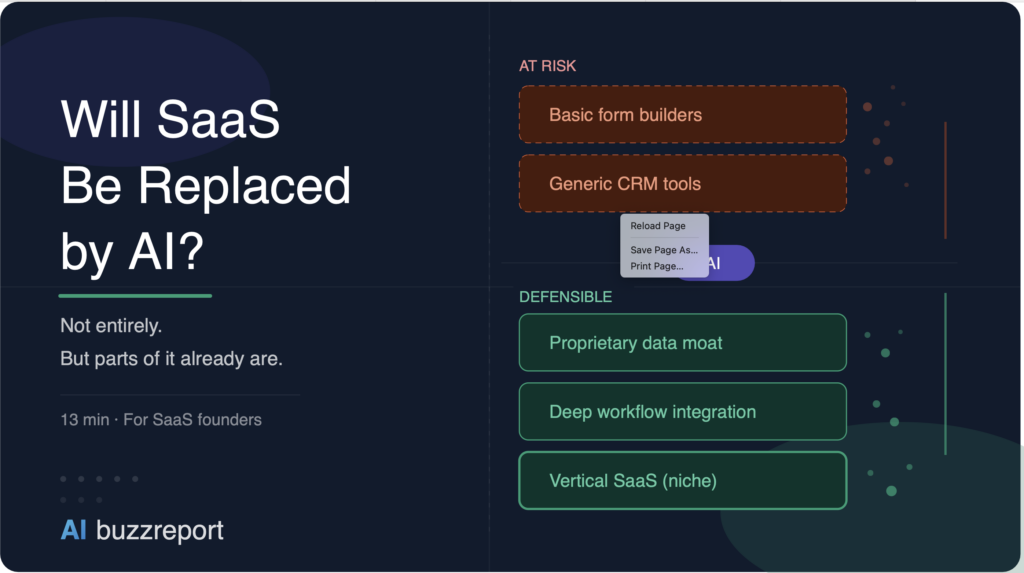
The short answer is: not entirely. But parts of it already are.
AI is moving fast. The AI software market is projected to reach $22.3 trillion by 2030 (IDC). Gartner says 75% of enterprise software will use AI for key decisions by 2028 as per data from the register.com. These are not small numbers. Something real is happening.
At the same time, SaaS is not going anywhere overnight.
Today, 90% of large enterprises still rely on SaaS for one simple reason: it is secure, consistent, and auditable in ways AI alone is not.
Here is the clearest way to think about it: AI is not replacing SaaS as a whole. It is replacing the weakest parts of SaaS. The tools that are simple, generic, and easy to replicate with a prompt. The stronger parts, products built on years of proprietary data, deep integrations, and complex workflows, are actually becoming harder to displace, not easier.
So the real question is not “will SaaS be replaced by AI?” The real question is: which side of that divide is your product on?
That is what this article helps you figure out.
What SaaS Actually Solved and Why That Context Matters
To understand what AI threatens, you first need to understand what SaaS was actually built to do.
Before SaaS, enterprise software was a capital expenditure. You bought a license, paid for servers, hired implementation consultants, and waited months before a single employee could log in. A mid-size company deploying CRM software in 2000 might spend $500,000 before the first contact record was ever entered.
SaaS solved a deployment and accessibility problem. It made professional-grade software available to any company, at any size, on a monthly subscription, with no infrastructure overhead. That was the genuine innovation for the entire tech industry and other industries.
The global Software as a Service (SaaS) market size is projected to grow to USD 1,482.44 billion by 2034, exhibiting a CAGR of 18.7% during the forecast period based on survey from Fortune BusinessInsights.
Three things drove SaaS to this scale, and understanding them matters because AI is only threatening one of them:
- Frictionless access
Before SaaS, professional software required servers, licenses, and months of implementation. SaaS made the same tools available to any team, at any size, on a monthly subscription with no IT overhead required.
- Predictable costs
Subscription pricing replaced six-figure capital expenditures. A 10-person startup could access the same CRM as a Fortune 500 company for a few hundred dollars a month.
- Elimination of IT barriers
Smaller companies were locked out of enterprise-grade tools entirely. SaaS removed that lock. The playing field did not just level, it flattened.
This distinction matters enormously when evaluating the AI threat. Because AI is not attacking SaaS’s delivery model. It is attacking something else: the assumption that making users navigate software interfaces is the right way to deliver software value.
Your Users Are Done Learning Your Software. AI Made That Official.
Every SaaS product built over the last two decades has relied on one assumption: users will learn to speak the software’s language.
This shows up everywhere—from navigating filters in Salesforce, to building workflows in HubSpot, to using shortcuts in Notion. The system defines how things work, and users adjust their behavior to fit it.
To support this, companies invest heavily in onboarding, documentation, and customer success, all focused on helping users understand and operate the software.
AI changes this model by shifting the burden from the user to the system. Instead of learning structured interfaces, users can express what they want in natural language, and the software interprets and executes it.
This shift is already visible in modern tools, where tasks can be completed by describing the outcome rather than navigating menus.
The impact goes beyond user experience. It changes how software creates value, especially for products built around organizing and retrieving information through interfaces.
If your product’s strength is helping users find and manipulate data, that advantage is weakening as AI removes the need to navigate the interface and allows users to get results directly.
What AI Cannot Replace and Why Most SaaS Founders Get This Wrong
Here is where the analysis in most “AI vs. SaaS” articles collapses into hand-waving. They point out that AI has limits and assume SaaS will survive, but rarely explain what actually makes SaaS defensible.
To understand that, you need to look at what AI cannot replace. Here are the key things to consider before questioning whether your SaaS can replace AI:
1. Your data Is the real advantage
AI can only work with the data it has access to. It does not automatically know your customers, your history, or your product usage patterns.
Your SaaS product does.
Over time, this data becomes highly valuable and difficult to replicate. Without it, AI gives generic outputs; with it, the same system becomes genuinely useful. The advantage is not just the software—it is the data behind it.
2. Reliability matters more than intelligence
AI systems are not always consistent. The same input can lead to slightly different results, which is fine for creative tasks but risky for critical operations.
SaaS platforms are built for consistency. They produce predictable outputs and keep a record of every action.
In areas like finance, healthcare, and legal, this reliability is essential. AI alone cannot meet that standard—it depends on structured systems to do so.
3. Software becomes infrastructure over time
The real strength of SaaS is how deeply it gets embedded into daily work.
When teams rely on Zendesk, Salesforce, or Jira, these tools become part of how the organization operates.
At that point, replacing them is not just a technical change—it is an operational one.
AI does not replace this layer. It builds on top of it. This changes how you should think about risk. The question is no longer whether AI will replace SaaS, but which parts of SaaS are actually vulnerable.
Because not all SaaS products are affected equally.
The Real Risk is For Commodity SaaS, Not the Entire SaaS Category.
So if AI cannot displace proprietary data, auditability, or deep workflow integration, what exactly is it threatening? The answer is specific, and it matters that you identify clearly whether your product falls inside it or outside it.
AI is not killing SaaS. But it is rapidly weakening a specific layer of it. And if your product sits in that layer, the impact will come sooner than most founders expect.
The most vulnerable category is commodity SaaS: tools that mainly provide a simple function through a clean interface. These typically include:
- Basic form builders
- Simple contact or CRM tools with no proprietary data layer
- Standalone dashboards pulling from a single data source
- Lightweight project or task trackers without deep workflow integration
What makes these products exposed is not poor execution. It is structural. Their value was always the interface: they made a simple function accessible. AI now makes that same function accessible through a natural language prompt, with no setup cost, no subscription, and no learning curve.
For a user who needs to track 50 contacts or build a basic intake form, the case for a dedicated SaaS subscription has genuinely weakened.
This does not mean these markets disappear overnight. Switching costs and organizational inertia are real. But the growth ceiling for commodity SaaS has dropped, and new customer acquisition in these categories is becoming measurably harder as AI-native alternatives multiply.
The question every founder in this space needs to answer honestly: is your product’s core value the interface, or is it the data and workflows sitting beneath it? If the answer is primarily the interface, you are building on ground that is being eroded.
If Your SaaS Product Is at Risk, Here Is What to Build Toward Instead
Knowing your product sits in the commodity tier is only useful if it points you somewhere. It does. The path out of commodity SaaS is not adding more features. It is rebuilding around a fundamentally different approach to how AI is used inside your product.
Most SaaS companies are currently doing one of two things with AI, and only one of them moves you out of the vulnerable tier.
The first approach: adding AI on top of what already exists
This is what most established SaaS companies are shipping right now.
An AI summary here. A suggested reply there. Natural language search bolted onto an existing interface.
These are real improvements and users notice them. But the product structure underneath has not changed. The screens, the data model, the workflow steps are all the same.
AI is filling in around the edges of something that was designed before AI existed. This approach is fast to ship. It is also easy for competitors to copy, and it does nothing to address the structural exposure of a product whose core value is still the interface.
The second approach: redesigning the product around what AI makes possible
Instead of asking “how do we add AI to what we built,” the question becomes: if users can describe what they want in plain language and AI can execute it automatically, what does this product actually need to look like?
The answer is almost always a product that is simpler to use on the surface and significantly more capable underneath. Less interface to navigate. Fewer manual steps. More of the work completing itself before the user has to ask.
Intercom made this shift visibly. Their AI now resolves roughly 50% of support requests without any human involvement — not by placing a chatbot on top of their existing product, but by building a system that reasons over their knowledge base, ticket history, and product documentation to produce real resolutions. The interface barely changed. What the product can actually do changed entirely.
The practical question for your own roadmap: where in your product is the user navigating instead of getting an outcome?
Every navigation step is a gap that AI can close. Every manual input that could be inferred is friction that a redesigned product eliminates. That is the direction commodity SaaS needs to move in and the sooner that work starts, the less ground there is to recover.
The Emerging Model: From Selling Software Access to Delivering Outcomes
When you start removing navigation steps and automating manual inputs, you are not just improving your product. You are changing what your product actually is.
The old SaaS model sold access: here is the platform, you do the work inside it, and you pay us monthly for the privilege.
The emerging model sells results: here is what we will accomplish for you, and the software is simply how we do it.
This is not a fringe idea. You do not cancel a product that is visibly producing a result. You cancel a product when you are not sure you still need it.
Think about what this means in practice. A product that says “we give you tools to reduce customer churn” is easy to deprioritize when budgets tighten. A product that says “our customers reduce churn by an average of 18% in the first 90 days” is much harder to cut, because cutting it means accepting that 18% loss back. The outcome is the retention mechanism, not the contract.
For SaaS founders, this reframing starts with one honest question: what is the single most measurable result your best customers consistently get from using your product?
Not the features they use. Not the workflows they run. The actual business outcome. That outcome is what your AI strategy, your positioning, and your pricing should all be built around.
The Three Defensible Positions for SaaS in an AI-Dominant Market
The market is not moving in one direction. It is stratifying. The SaaS companies that will compound their position over the next five years will be concentrated in three defensible positions.
Position 1: Proprietary data network
The most durable moat in SaaS has always been data, but AI makes it dramatically more valuable. If your platform aggregates unique behavioral or transactional data across a large user base — the kind of data that no AI model can be trained on from public sources — you have an asset that compounds rather than depreciates.
Snowflake’s competitive position is fundamentally a data network position. So is HubSpot’s. The platform is the container; the aggregated data is the actual moat.
Position 2: Deep vertical integration
Horizontal AI tools are commoditizing rapidly because the use cases are general.
Vertical SaaS products built for specific industries with deep workflow integration, industry-specific data models, and regulatory compliance built in faces a much slower commoditisation curve. The cost to replace a deeply integrated vertical SaaS product is not just the software cost. It is the retraining cost, the workflow redesign cost, the compliance re-certification cost.
AI does not eliminate these switching costs; in many cases, it increases them.
Position 3: Execution infrastructure
AI agents need reliable, consistent systems to act within. Platforms that provide this infrastructure — the APIs, the data models, the permission systems, the audit trails become more valuable as agentic AI deployment scales, not less.
If your SaaS is the system of record that AI agents write to and read from, you are not being displaced by AI. You are becoming the foundation it runs on.
A Diagnostic for SaaS Founders: Where Does Your Product Stand?
Before concluding with generic advice, here is a more useful exercise: a three-question diagnostic you can run against your own product today.
Question 1: If a competent user could describe their goal to an AI in plain language and get the same output your product produces, how long would that take to build?
Answer: If the answer is “a few hours with the right API access,” your interface is your moat — and that moat is thin. If the answer is “they would need five years of our customer data and deep integrations with twelve enterprise systems,” your moat is structural.
Question 2: What percentage of your product’s active usage is navigation versus decision-making?
Answer: Navigation is clicking through screens to find or organize information. Decision-making is using information your product provides to make a call. High navigation percentage means high AI displacement risk. High decision-making percentage means AI augments your product rather than replacing it.
Question 3: What does your product know about your customers’ business that no external AI model could?
If your answer is vague — “their contact data,” “their basic preferences” — your data asset is shallow. If your answer is specific — “we have 40 months of behavioral data showing exactly which product signals precede enterprise expansion” — you have a data asset worth building a roadmap around.
If you worked through all three questions honestly, you now know exactly where your product stands. The next step is knowing what to do about it.
What to Do Now: Three Moves That Compound
The diagnostic tells you where you stand. These three moves determine where you end up.
Move 1: Audit your interface overhead
Map every step in your core user workflow. Identify where users are navigating rather than deciding. These navigation steps are your highest-priority AI automation targets — not because they are the most impressive technically, but because eliminating them directly reduces time-to-value for your users, which is the metric that drives retention.
Move 2: Reframe your positioning around outcomes
Pick the single most measurable outcome your best customers consistently achieve with your product. Build your messaging, your onboarding, and your success metrics around that outcome. “We help you do X” positions you as a tool. “Our customers achieve Y” positions you as infrastructure.
Move 3: Accelerate your data strategy
The data your platform collects today is the training material for the AI features you will ship in two years. Every product decision that increases the depth, specificity, and uniqueness of the data your platform aggregates is compounding. Every product decision that makes your platform more generic is eroding the asset that will differentiate you when AI capabilities are fully commoditised.
None of these moves require a full product rebuild or a new engineering team. They require a decision to stop optimizing the product you built and start building toward where the market is heading.
The Honest Conclusion: Whether AI Will Replace Your SaaS Product
AI will not replace SaaS. It is already replacing the weakest tier of SaaS like commodity tools built on interface value alone and it is accelerating the advantage of SaaS companies with deep data, deep integrations, and a clear line of sight to measurable customer outcomes.
For SaaS founders and product leaders, the risk is not AI. The risk is misreading the signal. Treating AI as a feature to add rather than a lens to evaluate your entire product strategy through. Optimizing for the product you built rather than the outcome your customers actually need. Assuming your current moat is deeper than it is.
The SaaS market is not ending. It is sorting. The companies that use this moment to diagnose their defensibility honestly and move on the findings will compound. The ones that wait for clarity will be waiting for something that is not coming.
Stay Ahead of the AI Curve
Get the latest AI trends, SaaS insights and tech news delivered to your inbox every week.
- ✦ Daily AI & SaaS news digest
- ✦ Exclusive founder insights
- ✦ Unsubscribe anytime
Tech Insights Daily
Free forever. No spam. Unsubscribe anytime.