What Is Agentic SaaS? The Complete Definition and Guide for SaaS Founders
SaaS platforms have experienced significant technological evolution over the past decade. Initially, these tools were designed to digitize business processes such as email communication, document management, and team collaboration.
While this shift improved accessibility and efficiency, most platforms still required significant manual input from users. The introduction of automation brought the next wave of innovation. SaaS companies began integrating automation features that could reduce repetitive tasks and streamline operational workflows.
Businesses could now automate data entry, notifications, and simple processes, which saved time and improved productivity.
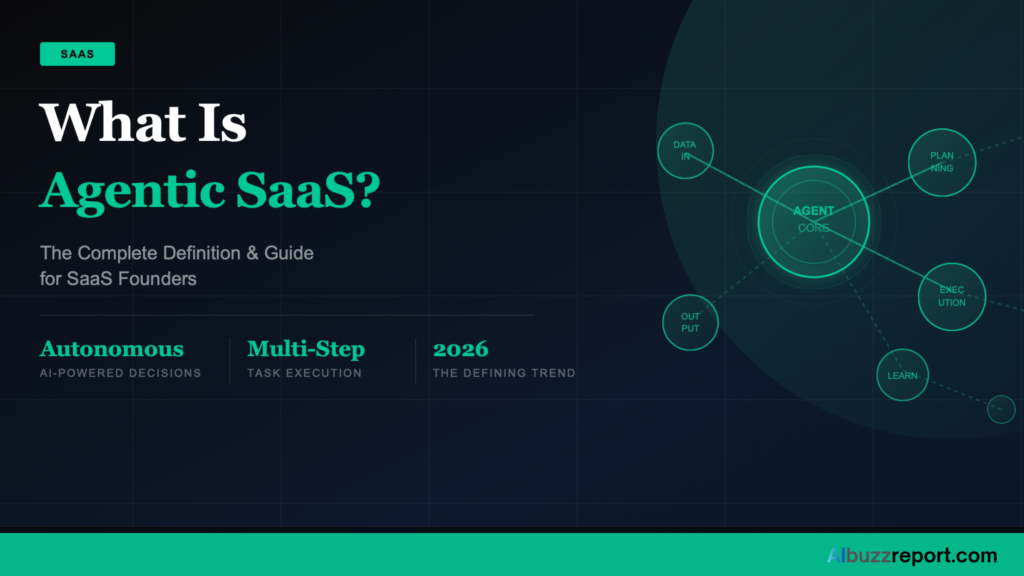
Agentic SaaS represents the latest breakthrough in this evolution. These are cloud-based applications powered by autonomous AI agents that independently analyze situations, make decisions, and execute complete tasks to deliver specific outcomes for users. Instead of users performing actions through buttons, forms, and dashboards, agentic SaaS receives high-level instructions and handles everything from planning through execution.
At AI Buzz Report’s SaaS category, we track how this shift transforms products for founders and product managers building or scaling SaaS businesses. This comprehensive guide explains agentic SaaS from definition through implementation, with practical steps every decision maker needs.
What Does Agentic SaaS Actually Means?
Agentic SaaS refers to cloud-based software applications that integrate autonomous AI agents capable of independently completing complex, multi-step tasks based on high-level user goals rather than requiring manual operation through traditional user interfaces. These AI agents observe available data across systems, reason through possible approaches, select optimal actions, execute them via APIs and integrations, and continuously improve performance through learning from outcomes.
How agentic SaaS fundamentally differs from previous generations
Early SaaS platforms digitized manual processes, requiring users to actively input data and trigger actions through point-and-click interfaces. Automation-enhanced SaaS introduced rule-based workflows that executed predefined sequences without constant human intervention. Agentic SaaS advances beyond both by deploying intelligent agents that demonstrate four essential capabilities: autonomous task execution, goal-oriented reasoning, contextual awareness across multiple data sources, and adaptive learning from real-world results. For example, rather than a user manually navigating through customer support tickets, account records, and billing systems to resolve a complaint, the agentic system receives the instruction “resolve customer billing dispute #1234” and independently coordinates all necessary actions.
The core technical architecture behind agentic SaaS
Agentic SaaS operates through a continuous cycle of observation, planning, execution, and reflection. The AI agent first gathers relevant context from connected systems including customer relationship management databases, support ticket histories, usage analytics, and external market data. It then decomposes the user goal into actionable steps, selects appropriate tools or APIs, performs the required operations, and evaluates results against success criteria. This architecture enables the software to handle dynamic business environments where conditions change rapidly, unlike static automation that follows fixed rules.
Practical example demonstrating agentic SaaS functionality
Consider a SaaS product designed for marketing teams. A user provides the instruction “increase email open rates for Q2 campaign targeting enterprise prospects.” The agentic system analyzes historical campaign performance, customer segmentation data, subject line effectiveness patterns, and current market benchmarks. It then autonomously tests multiple subject line variations, schedules optimal send times, monitors real-time engagement metrics, adjusts delivery sequences for non-responders, and generates a comprehensive performance report with actionable recommendations. The user receives completed results rather than intermediate tools requiring manual configuration.
Why Agentic SaaS Matters for SaaS Founders Today
Agentic SaaS addresses fundamental challenges faced by SaaS founders and product managers who must deliver increasing value while managing constrained resources and rising customer expectations for intelligent automation.
Current competitive pressures demand proactive software solutions
SaaS customers increasingly expect products that deliver measurable business outcomes rather than requiring extensive user training and manual operation. Founders face pressure to differentiate in crowded markets where basic automation has become table stakes. Agentic SaaS creates defensible competitive advantages through intelligent, adaptive functionality that embeds deeply within customer workflows and reduces churn through consistent value delivery. Companies building agentic capabilities establish leadership positions in emerging categories and command premium pricing for outcome-based solutions.
Operational efficiency gains enable leaner team structures
SaaS businesses traditionally scale through hiring additional customer support, sales development, and operations personnel. Agentic SaaS replaces these functions with software agents that operate continuously without salary costs, benefits, or management overhead. Product managers gain visibility into automated processes through centralized dashboards while eliminating the coordination required for human teams. This structural advantage allows bootstrapped founders to compete with well-funded competitors through superior operational leverage.
Customer retention improves through intelligent, personalized experiences
Users abandon SaaS products that demand excessive time investment for basic functionality. Agentic SaaS continuously analyzes individual user behavior and business context to deliver proactively customized experiences. Marketing platform agents adapt content recommendations based on real-time campaign performance. Support agents anticipate issues before formal tickets arise. These capabilities create “sticky” products where customers perceive the software as an indispensable business partner rather than interchangeable commodity tools.
Four Key Characteristics That Define Agentic SaaS
Agentic SaaS demonstrates distinct capabilities that separate it from basic AI features or traditional automation, enabling founders to build genuinely autonomous products.
1. Autonomous task execution handles complete workflows independently
Agentic SaaS agents manage end-to-end business processes without requiring human intervention at intermediate steps. In a customer relationship management application, a lead qualification agent receives a new prospect record and independently performs lead scoring, personalized outreach composition, email delivery scheduling, response analysis, CRM record updates, and calendar booking for qualified opportunities. This complete workflow ownership eliminates fragmentation across multiple tools and team members, reducing process completion time from days to minutes.
2. Goal-oriented reasoning adapts strategies to achieve business objectives
Unlike rule-based automation limited to predefined scenarios, agentic agents receive high-level business objectives and independently determine optimal execution paths. A revenue operations agent tasked with “increase monthly recurring revenue by 15% from existing customers” analyzes usage patterns, identifies expansion opportunities, tests pricing adjustment strategies, monitors conversion impact, and iterates successful approaches. Founders specify desired outcomes while agents handle tactical implementation and continuous optimization.
3. Contextual awareness integrates data from multiple sources for intelligent decisions
Effective business decisions require comprehensive situational understanding. Agentic SaaS agents aggregate and analyze information across siloed systems including customer databases, support platforms, financial records, usage analytics, and external market intelligence. A supply chain management agent monitoring inventory levels cross-references sales forecasts, supplier performance history, shipping delays, and economic indicators to make proactive replenishment decisions that balance costs against stockout risks.
4. Continuous learning improves performance through real-world experience
Agentic systems build institutional knowledge from actual business outcomes rather than relying on static training data. Support agents analyze resolution success rates across thousands of interactions to prioritize proven solutions for common issues. Sales agents refine outreach strategies based on measured reply and conversion rates. This self-improvement capability ensures SaaS products become increasingly valuable to customers over time, creating natural retention advantages.
The Difference Between Agentic SaaS and Traditional SaaS
Agentic SaaS fundamentally rearchitects software around outcomes rather than interfaces, creating dramatically different user and business experiences.
| Aspect of Operation | Traditional SaaS Experience | Agentic SaaS Experience |
| User Role and Responsibilities | Users actively perform all tasks through menus, forms, and manual workflows | Users define goals; agents execute complete solutions autonomously |
| Process Design and Flexibility | Fixed workflows requiring developer updates for business requirement changes | Dynamic reasoning adapts processes to current data and learned patterns continuously |
| System Interaction Method | Complex user interfaces with multiple navigation steps and data entry requirements | Natural language instructions processed through conversational or goal-based interfaces |
| Task Execution and Completion | Sequential human-driven actions with approval gates at critical steps | Independent planning, execution, verification, and iteration cycles |
| Business Value Delivery Model | Provides productivity tools requiring customer interpretation and execution | Delivers complete business outcomes ready for immediate business use |
| Operational Scaling Mechanism | Additional licensing revenue requires proportional support and service infrastructure | Infinite scaling through compute resources without corresponding service overhead |
4 Benefits Agentic SaaS Delivers to SaaS Companies
Agentic SaaS creates measurable improvements across core business functions that directly impact founder priorities.
1. Complete process automation eliminates manual coordination
Agentic systems own entire business functions rather than individual tasks. Sales development agents progress leads from initial identification through qualification, nurturing, and opportunity handoff without requiring sales team intervention. Customer success agents monitor usage patterns, trigger personalized engagement workflows, and execute retention campaigns autonomously. These capabilities compress weeks of human effort into automated minutes.
2. Employee productivity shifts toward high-value strategic work
Knowledge workers spend 60% of time on repetitive coordination and data handling. Agentic SaaS redirects this capacity toward innovation and relationship building. Customer support teams focus exclusively on strategic account management rather than ticket triage. Marketing professionals design campaigns rather than maintaining lists. Founders gain high-leverage teams without headcount expansion.
3. Proactive issue resolution prevents business disruptions
Traditional systems react to problems after they impact revenue. Agentic agents continuously monitor key indicators and intervene before issues escalate. Revenue recognition agents detect billing discrepancies during invoice generation rather than during customer complaints. Churn prediction agents execute retention workflows when early warning signals appear in usage data. This forward-looking approach preserves customer lifetime value.
4. Hyper-personalization scales individual experiences profitably
Enterprise customers demand custom solutions without custom pricing. Agentic SaaS analyzes individual user patterns and business context to deliver tailored functionality automatically. Dashboard layouts adapt to analysis preferences. Workflow recommendations reflect historical success patterns. Feature adoption guidance personalizes to role and experience level. These capabilities drive 30% higher engagement without dedicated account team resources.
Agentic SaaS Success Stories from Leading Companies
Real-world implementations demonstrate agentic SaaS maturity and business impact across industries.
Enterprise sales platforms execute complete revenue cycles ( Salesforce)
Salesforce Agentforce coordinates full go-to-market motions including territory analysis, account prioritization, personalized outreach sequencing, meeting preparation, proposal generation, negotiation support, and contract execution. Sales teams receive pre-qualified opportunities with complete context rather than cold leads requiring manual research and nurturing.
Marketing automation platforms orchestrate customer journeys (HubSpot)
HubSpot AI agents autonomously manage complete lead nurturing programs including segmentation, content personalization, multi-channel delivery optimization, performance analysis, and iterative improvement. Marketing teams receive campaign summaries and actionable insights rather than managing individual email sends and list maintenance.
Customer support systems resolve complex issues independently
Modern support platforms deploy specialized agents for technical troubleshooting, billing resolution, product onboarding, and policy exception handling. These agents integrate across knowledge bases, ticketing systems, product usage data, and billing platforms to deliver solutions without human escalation for 70% of interactions.
5 Simple Steps to Build Agentic SaaS in Your Product
Non-technical founders implement agentic capabilities through proven implementation patterns.
Step 1: Identify high-ROI problem areas with clear success metrics
Successful agentic implementations target processes with high manual effort and predictable patterns. Customer support ticket resolution serves as the ideal starting point due to consistent problem types and measurable outcomes. Sales lead qualification represents another strong candidate where qualification criteria remain relatively stable. Document current manual process time and error rates to establish baseline metrics for improvement measurement.
Step 2: Select accessible development platforms matching your technical capacity
Non-technical teams begin with no-code agent builders including Zapier for simple API orchestration, n8n for visual workflow design, or Bubble for complete application prototyping. Technical teams leverage LangChain or LlamaIndex frameworks for sophisticated reasoning capabilities. Connect initial agents to existing data sources including CRM platforms, support systems, and internal databases within the first development sprint.
Step 3: Define precise, measurable goals with clear success boundaries
Effective agent instructions specify desired outcomes, acceptance criteria, and escalation triggers. Support agents receive instructions including “resolve billing inquiries with 90% first-contact success rate within 5 minutes, escalating accounts over $1000 or repeat complaints to human specialists.” Test instruction clarity through small-batch validation before full deployment.
Step 4: Launch controlled pilots with comprehensive monitoring
Deploy agents to 10% of eligible volume initially while capturing complete execution logs including input context, reasoning steps, API calls, and outcome results. Establish monitoring dashboards tracking key metrics such as task completion rate, time savings, error frequency, and user satisfaction. Conduct weekly reviews adjusting agent instructions and decision boundaries based on observed performance patterns.
Step 5: Expand scope methodically after establishing performance baselines
Scale to full volume only after achieving 80% automation rate with acceptable accuracy. Extend agentic capabilities to adjacent workflows sharing similar data patterns and decision logic. Document lessons learned and establish governance processes for agent monitoring, updating, and compliance. Most teams achieve enterprise-scale deployment within 90 days of initial pilot success.
3 Challenges You Face Building Agentic SaaS and How to Fix Them
Implementation obstacles prove manageable through systematic approaches proven across hundreds of deployments.
Challenge 1: Agent reasoning errors on complex edge cases require structured safeguards
AI systems occasionally misinterpret nuanced business scenarios or ambiguous instructions.
Solution: Implement human-in-the-loop validation for high-value transactions during initial deployment phases. Define clear escalation criteria including monetary thresholds, customer sentiment indicators, and multi-turn interaction complexity. Gradual autonomy expansion correlates with observed accuracy improvements.
Challenge 2: Data integration complexity across fragmented systems demands prioritization
Most SaaS businesses maintain data across multiple platforms requiring sophisticated orchestration.
Solution Begin with highest-value data sources demonstrating immediate ROI potential. Implement API rate limiting, caching strategies, and connection pooling to ensure reliable performance under production workloads. Document integration patterns for repeatable scaling
Challenge 3: Cost management requires predictable usage forecasting and optimization
Compute-intensive agent operations generate variable cloud expenses.
Solution: Establish daily execution budgets and per-task cost monitoring from initial deployment. Optimize through model selection appropriate to task complexity, response caching for repetitive queries, and batch processing where latency tolerance permits. Track cost-per-successful-outcome as primary efficiency metric.
2 Trends Shaping the Future of Agentic SaaS
Agentic architecture becomes table stakes for new SaaS development within three years as platforms standardize agent orchestration frameworks and outcome-based pricing models.
Multi-agent collaboration systems coordinate specialized capabilities
Future agentic SaaS coordinates teams of purpose-built specialists rather than generalist agents. Sales agents collaborate with support agents for complete customer context. Marketing agents synchronize with finance agents for budget compliance. Orchestration platforms emerge enabling seamless inter-agent communication and shared context.
Vertical industry specialization accelerates adoption rates
Healthcare agentic platforms coordinate patient journey management across electronic health records, billing systems, and care coordination workflows. Financial services agents handle complete regulatory compliance cycles including transaction monitoring, exception identification, and reporting generation. Industry-specific reasoning delivers outsized value creation.
Next Steps for SaaS Founders
Agentic SaaS creates genuinely autonomous products that deliver business outcomes rather than requiring constant human operation. Founders gain sustainable competitive advantages through operational leverage, customer retention improvements, and scalable personalization capabilities.
Subscribe to AI Buzz Report’s newsletter for weekly insights covering agentic SaaS platforms, implementation case studies, and emerging frameworks. Join thousands of founders building the next generation of intelligent software products.
Join founders and tech enthusiasts who read AI Buzz Report.
Stay Ahead of the AI Curve
Get the latest AI trends, SaaS insights and tech news delivered to your inbox every week.
- ✦ Daily AI & SaaS news digest
- ✦ Exclusive founder insights
- ✦ Unsubscribe anytime
Tech Insights Daily
Free forever. No spam. Unsubscribe anytime.